
More About the Bible: Part 4

Let us make man in our image.

Yet To Be #187

Genesis

Author: Moses

Written: between 1446 and 1406 BC

Details:

  • first book of the Hebrew Bible called bereshit or in the beginning and the first book of the Christian Bible.
  • Genesis is the Greek word meaning origin or beginning.
  • First book of the Torah or the Law
  • Primeval history
  • Ancestral history

First Line sets the tone of the entire book, “In the beginning God created the heaven and the earth.” Genesis 1:1.

The Primeval history consists of relationships. The first relationship presented and most important, is the relationship between God and the Son as mapped out in the name of God or Elohim. The root El translated from Hebrew into English for God, the first name of God as seen in Genesis 1:1. Elohim is the plural for God. The Hebrews of the Old Testament had only one God who was Yahweh. They believed in monotheism which is the worship of one God. As Elohim is plural and Eloah is singular, this is the first evidence that the Son was with God the Father in eternity past before the creation.
And God said, “let us make man in our image, after our likeness.” (Genesis 1:26) In the beginning, before time began, He was not alone but, is speaking with someone else.
Then there is the relationship between God and man and the relationship between man and beasts and then man and woman as seen in the creation story. (Chapters 1- 11)
The ancestral history details the rise of the nation of Israel as God’s chosen people and God’s covenant to Abraham (the patriarch) and his descendants. (Chapters 12-50)

Overview

  • Creation and the fall, (so-called original sin, casting out of the Garden, first promise of God, first murder and first murderer, the story of Cain and Abel) 1:1-5:32
  • Noah and his descendants, (the Ark, the Deluge, tower of Babel, dividing of language) 6:1-11:26
  • Abram (Abraham) and his descendants, (command to leave the Ur of the Chaldees, Covenant of God with Abram, Melchizedek the King of Salem and high priest of El Elyon is introduced, the destruction of Sodom and Gomorrah, Lot’s Wife, the birth of Moab and Ammon, Ishmael of Haggai, Abraham’s last test, the sacrifice of Isaac and Abraham’s belief in the promise of God and belief in resurrection is introduced) 11:27-25:18
  • Story of Isaac, Jacob, and Esau, (stolen birthright, Jacob, Leah, and Rachel, birth of Edom, the twelve sons of Jacob, brotherly jealousy, coat of many colors)25:19-36:43
  • Story of Joseph, (coat of many colors destroyed, Joseph sold into slavery, Joseph becomes governor, reunion of all the brothers and forgiveness, Jacob journeys to Egypt, the families all go down to Egypt and Joseph’s death) 37:1-50:26

More About the Bible: Part 2 the Two Testaments

the Bible is divided into two sections called the old testament and the new testament.

Yet To Be # 185

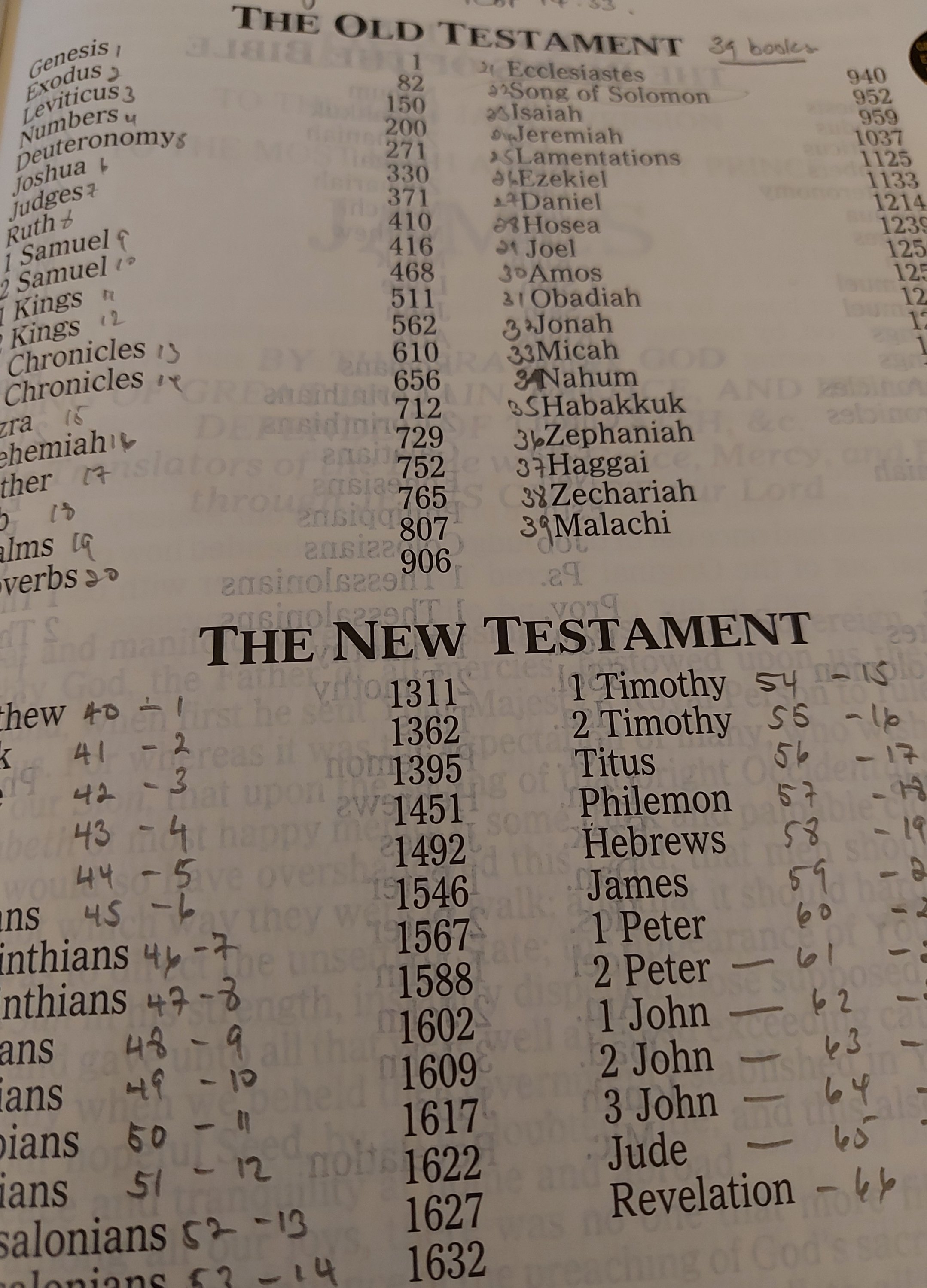
The Bible is divided into two sections called the Old Testament and the New Testament. There is a total of sixty- six books in the Christian Bible, the Old Testament consists of thirty-nine books whereas the New Testament consists of twenty-seven books. 

Historical Fact:

The Old Testament was first coined by Melito of Sardis a Greek Bishop in the 2nd Century CE at Lydia which is today, Turkey.

A testament of the Bible is a historical record of God’s promise or covenant.

Quick Facts Old Testament (OT) VS Testament (NT)

  • OT is the history of a people 
  • NT speaks of a person
  • OT is based on the law as given by Moses
  • NT is based on the grace of God as seen in Jesus Christ 
  • OT is about his chosen people the Jews/Hebrews
  • NT is about the church
  • OT views the wrath of God against sin 
  • NT shows the grace of God towards sinners 
  • OT predicts the Messiah (Isaiah 53) 
  • NT reveals the Messiah (John 4:25-26)
  • OT presents God’s Law
  • NT Jesus the Messiah fulfills that law 
  • OT the blessings are physical 
  • NT the blessings are spiritual
  • OT shows the beginning of days (Creation)
  • NT shows the end of days (God will put all things right) 
  • OT forecasts the sufferings of Christ (Psalms) 
  • NT the fulfillment of the sufferings of Christ (Gospels) 
  • OT old creation (Genesis) 
  • NT new creation
  • OT first Adam (Genesis) 
  • NT last Adam (Gospels) 

Yet To Be #99

For God so loved the world

Day 10 The Word was God

The fourth book of the new testament called the Gospel According to John was written from AD 85 to AD 90.


The disciple and Apostle John looks at the “humanity of Christ while never losing sight of Christ’s divine nature.” It opens with the same words of the first book in the Bible, Genesis, in the beginning before time was the Word was, and the Word was with God and the Word was God.
The relationship between the Father and the Son is initialized in this verse and sets up the main purpose of the entire book which is to explore this unique union.


John’s presentation of Jesus as the Son of God is evident in the famous and keynote verse 16 of chapter 3.


For God so loved the world that he gave his only begotten son that whosoever believe on his name shall not perish but have everlasting life.

Yet To Be #87

Don’t be afraid. Life goes on.

Don’t Be Afraid

Cherry Blossoms Through the Window…

Life goes on;

Babies are born and people grow old.

Things change, nothing stays the same.

Where does it all go?

When time ends would there be an answer?

Would there be a second chance? 

Time slips by and nothing changes.

The future is a whisper of a promise. 

Delicate.

Invisible.

Possible. 

But today is now. 

It is what it can be.

And it came to pass, when she was in hard labour, that the midwife said unto her, Fear Not; thou shalt have this son (child) also. Genesis 35 verse 17

Yet To Be #29

Our existence depends on so many external factors

Today’s Inspire

Pathway

#1 Time Thief

Time thief is not a game, but something that steals precious moments and derails goals, if not for a second, but for a couple of minutes or more. 

What is time?  “Time is represented through change such as the circular motion of the moon around the Earth.”  Moving from one instance to another from the very beginning of…time.

“In the beginning…God called the light Day, and the darkness he called Night. And the evening and the morning were the first day.” Genesis ( the beginning, the first book, the origin) 1 verse 5 

As humans on this earth, we are all subjected to time; we are born, we live and then we die. Our existence depends on so many external factors, whereby, we have no control. Time can pass into eternity in a blink of the eye and we cannot stop it, neither can we turn it back. If we cease to exist, time will still go on because it is not dependent on us to shape its existence but, we depend on it to shape ours. Humanly speaking, time is the thief of itself. (Vicissitudes of Life, 2007)

#2 Time Change – moving into eternity

# 3 Redeeming the time – taking the rest of your life and doing it right.  We can work on today with the hope of tomorrow.

#4 Time is running out – missed opportunities. The end of time via sickness or death.

#5 Holding onto time – is it possible when time changes?

#6 Procrastination – folding of the arms – one of the seven deadly sins – sloth